Friday, March 25, 2022

Maiden, Mother, Crone, edited by Gwen Benaway

I was directed to this book, published in 2019, to read one specific story, but as I've never before encountered an anthology made up of stories about "fantastical trans femmes" I thought I'd read the whole thing. It's fairly short, eleven stories spread out in under 150 pages.  A few stories were underdeveloped, and clearly by writers still learning the craft. Most were okay or passable stories, but they all encompassed some similarities: the trans protagonists all have a sense of being very special, together with an aggrieved sense of being misunderstood and looked down upon. With one exception, all the males in the stories are there to be evil. One story ("Freeing the Bitch") reads completely like fanfiction--all the boxes of representation and identity are successively checked, as if that is the point of storytelling. The story that was recommended  to me ("i shall remains"--yes the author refuses conventional punctuation and capitalization) was indeed interesting-- a deliberate response to Ursula K. Le Guin's famous story "Those Who Walk Away from Omelas," which is quoted in the  headnote to the story. The book's editor (who also contributed one story) Gwen Benaway described herself as "a trans girl of Anishinaabe and Metis descent"--indiginous peoples of the Great Lakes area of Canada and the U.S. The truth of this assertion was questioned (on Twitter and elsewhere) in 2020, and Benaway has since been cancelled. The publisher of this book, Bedside Press, ceased operations in 2021.  I have no idea if the two events are related, but the book is now out of print and copies are scarce. So it goes. 

Friday, March 11, 2022

The Haunting Season: Eight Ghostly Tales for Long Winter Nights

The Haunting Season is an odd volume containing eight stories by eight supposed bestselling writers. The writers are seven women and one man. No editor is credited, so one wonders: how did stories get selected for this book? All eight writers are British, and none seem to be especially known on this side of the Atlantic. I've read novels by two of them before, the one by Bridget Collins was reviewed at this site on January 30, 2019. Collins's story opens this volume, and I found it as unsatisfying as her novel. Stories by Imogen Hermes Gowar, Laura Purcell, and Kirin Millwood Hargrave, are somewhat traditional. Stories by Andrew Michael Hurley (the other author I've read before) and Elizabeth Macneal attempt to do something more unusual, but they don't pull it off successfully. The story by Jess Kidd  begins with a photographer called in to photograph an extremely beautiful young dead woman. It pulls the reader in, but soon goes off in tangents, leaving an unsatisfying denouement. The story by Natasha Pulley ("The Eel Singers") is the strangest and most interesting one in the book: odd characters are affected by the landscape and history of an isolated region of the fens. As a themed anthology, the book doesn't work. As a modern example of the ghostly tradition, the book doesn't work. None of the stories are terrible, but none are especially good. Most of them read like first drafts--which could have been bettered with some thought applied to them during revision. A disappointment overall.

Thursday, March 3, 2022

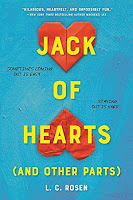
Jack of Hearts (and Other Parts) by L.C. Rosen

Religious zealotry is once again operating in full force, as increasingly books are being banned on topics that such zealots deem should be silenced. These include ideas related to race and to LGBTQ issues. Jack of Hearts (and Other Parts) (2018)  by L.C. Rosen is one such challenged title (which I learned of and read because of the nudnik challenges). It concerns a gay New York City high schooler who conducts a (off-school) website sex column while at the same time being stalked and threatened by an anonymous supposed admirer. Books like this which exhibit sympathy and understanding of sexual (and other) minorities should not be banned by myopic zealots, but stocked openly in every high school library.

Monday, February 21, 2022

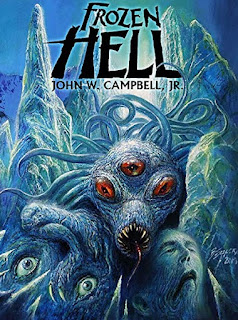
Frozen Hell by John W. Campbell Jr.

Frozen Hell is the original manuscript version of John W. Campbell, Jr.'s, 1938 novella "Who Goes There?"--better known via various filmed versions, The Thing from Another World (1951), John Carpenter's The Thing (1982), and the very similarly plotted prequel, also titled The Thing (2011). This new edition is probably the worst example of shameless exploitation and overhype that I've ever encountered. The Preface attempts (and fails) to add excitement to the discovery of this lost first version (it was found in a library archive, wow). A long Introduction by Robert Silverberg puts the story in context. "Frozen Hell" itself is basically the same as "Who Goes There?" but with three slow and uninteresting extra chapters at the beginning. Padding out this slim volume further are five preview chapters of a proposed sequel, to be written by the publisher, but the writing of this is so filled with cliches of phrasing and of situation that one can only hope that the world is spared from any more. Silverberg aptly notes that Campbell's dropping of the first three chapters was a great improvement.  "Who Goes There?" is worth reading.  This resurrected discarded draft is not. 

Monday, February 14, 2022

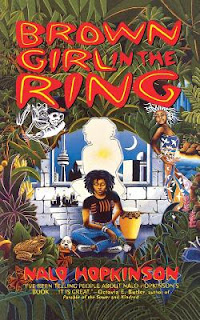
Brown Girl in the Ring by Nalo Hopkinson

Published in 1998, this is a tale of Carribbean magic transplanted to a future post-apocalypse Toronto. In another sense it is a coming of age family story. Ti-Jeanne has just had a baby, and settles with her grandmother, a folk healer and magic practitioner. The baby's father is ominously tied in with the posse of organized crime, run by Rudy, who is kept young by an enslaved duppy who is fed childrens' blood but who must also follow Rudy's murderous orders.  Ti-Jeanne of course runs afowl of Rudy, who it turns out is her grandfather, and Ti-Jeanne gets some aid from the duppy, who turns out to be her mother's spirit. It's a competent tale, but not much more. 

Wednesday, January 12, 2022

Piranesi by Susanna Clarke

Piranesi (2020) by Susanna Clarke is an odd and difficult to describe fantasy novel. It begins with the eponymous character nearly alone in a world of massive architectural halls, sometimes underwater, all mapped out carefully over the years by Piranesi. Yet some aspects of the author's world-building don't quite fit (that is, why does Piranesi know of concepts and things from our modern world), but eventually (via reading his old journals) Clarke brings in a mystery of the real world that brought Piranesi to this world, at the same time as the process erased most of his memories. The set-up is initially too long, and (unusually) the middle section of the book, unravelling the real world mystery of academic rivalries exploring mystical dimensions, is the most gripping part, leaving the resolution rather disappointing. Though imperfect in minor ways, Piranesi is still a fine if strange novel. 

Sunday, December 26, 2021

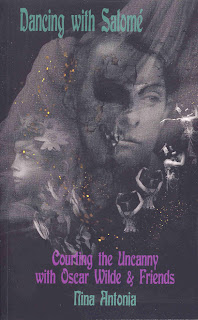
Dancing with Salome by Nina Antonia

With Dancing with Salome: Courting the Uncanny with Oscar Wilde and Friends (2021) by Nina Antonia, one should ignore the main title (referencing Wilde's macabre play) and cue into the subtitle for the descriptive phrase that tells the reader what this book is about, and why one should want to read it. The small book consists of four essays, plus an introduction by Therese Taylor and a shorter introduction by the author. The first essay covers the supernatural thread in Oscar Wilde's life, while the second discusses "the supernatural affair of Lord Alfred Douglas and Oscar Wilde."  The third explicates Aleister Crowley's unsuccessful attempts to goad Douglas into a lawsuit, and the final one is on the life of Lionel Johnson, the friend of Douglas who introduced him to Wilde, who was also the subject of a previous volume by Antonia, Incurable: The Haunted Writings of Lionel Johnson, the Decadent Era's Dark Angel (2018). Dancing with Salome is an intriguing look at the occult aspects of Wilde and of his friends in the 1890s, a subject usually given short shrift in books for more general audiences.  I found it well-written and illuminating.